
Fixing the Financial Leak: A Clinician's Guide to Revenue Integrity and Cost Reduction in Modern Hospitals

Healthcare institutions operate at the intersection of clinical excellence and financial sustainability. Yet a paradox persists across hospital systems globally: patient volumes rise, clinical teams expand, and services diversify—but financial performance fails to keep pace. The silent culprit, in most cases, is not inadequate revenue generation but unchecked revenue leakage. Small, often invisible losses compound across billing cycles, departments, and procurement channels until they represent a measurable threat to institutional viability.
This article, developed from insights shared by healthcare industry experts & Cost Variance Analysts, outlines the systemic origins of revenue leakage, evidence-informed strategies to contain it, and practical cost-reduction frameworks that hospital administrators and clinical leaders can implement without compromising the standard of patient care.
Understanding Revenue Leakage in Healthcare
Revenue leakage refers to unplanned, unrecorded, or recoverable financial loss that occurs outside the awareness of hospital management. Unlike overt financial fraud, leakage is insidious—it blends seamlessly into routine operations, making it difficult to detect through conventional oversight.
Common sources of revenue leakage include:
Manual processing errors in billing and documentation
Missed or incorrect billing for inpatient services, materials, and pharmacy items
Unplanned or undocumented discounts granted without authorization
Unresolved or improperly followed-up insurance claims
Insurance denials and systemic underpayments
Clinical Illustration: Consider a 200-bed tertiary care hospital where post-operative pharmacy items—IV fluids, consumables, and high-value medications—are dispensed manually and documented on paper. When billing is generated 24–48 hours later, several items go unrecorded due to shift changes and illegible handwriting. Over a month, this results in tens of thousands of rupees in unrecovered costs. Multiplied across surgery, ICU, and emergency departments, the annual leakage is substantial—and entirely preventable.
Industry data suggests that even a 1–5% revenue leakage on total annual revenue can threaten a hospital's financial resilience. For a mid-sized hospital generating ₹50 crore annually, that translates to ₹50–250 lakhs in preventable losses each year.

Why Revenue Leakage Is a Patient Care Issue, Not Just a Financial One
Revenue leakage is frequently categorized as a finance department concern. In reality, its consequences extend directly into clinical operations. Unaddressed financial losses produce a cascade of effects:
Reduction in total net revenue available for reinvestment
Constrained cash flow, affecting timely procurement of drugs, consumables, and equipment
Deferred infrastructure upgrades that impact diagnostic and treatment quality
Financial instability that jeopardizes compliance with regulatory and accreditation standards
A hospital that cannot sustain financial health cannot sustain clinical excellence. The two are inextricably linked.
Root Causes: Systemic, Not Individual
A critical insight from the conclave was that revenue leakage is rarely the result of individual negligence. It emerges from fragmented systems, poorly integrated workflows, and inadequate data governance. Identified root causes include:
Incomplete or inaccurate patient registration and demographic data
Insufficient insurance eligibility verification at the point of admission
Weak inter-departmental communication between clinical and billing teams
Manual data entry and paper-based billing processes
Inadequate documentation of procedures, consumables, and medications
Errors in provider–insurer contractual agreements
Absence of real-time cost tracking and operating expenditure controls
Unplanned emergency purchases driven by poor inventory forecasting
Suboptimal asset tracking and medical equipment utilisation
Inefficient workforce scheduling leading to role duplication or gaps
Clinical Illustration: A patient is admitted under a corporate insurance policy. The admissions desk fails to verify the exact coverage clauses. Over a five-day stay, the clinical team administers several implants and investigations not covered under the policy. At the time of discharge, the insurer denies ₹80,000 of the claim. The root cause was not clinical—it was a failure of insurance verification at admission. This scenario repeats hundreds of times in unintegrated systems.

The Integrated Hospital Management System: The First Line of Defense
The most powerful and scalable intervention for revenue leakage is the implementation of a well-configured, integrated Hospital Management System (HMS). An effective HMS is not merely a billing tool—it is the digital nervous system of the institution.
An ideal HMS must:
Be calibrated to the specific size, specialty mix, and patient population of the facility
Integrate all departments—Pharmacy, Laboratory, Radiology, Stores, Accounts, and Auditing—into a single data ecosystem
Link the complete patient care cycle, from registration and triage to discharge and follow-up
Enable real-time data flow with automated alerts and error-flagging mechanisms
Capture comprehensive patient, insurance, and clinical data at the point of first contact
Clinical Illustration: A hospital that previously operated separate pharmacy, lab, and billing systems migrated to an integrated HMS. Within the first quarter, the system automatically flagged 340 instances of administered medications that had not been billed—an average of nearly 4 missed billing entries per day. Upon cross-referencing with nursing notes and medication administration records, 80% were validated as legitimate charges. Total recovered revenue in the first month alone was ₹6.2 lakhs.
Patient Engagement as a Revenue Safeguard
Effective patient communication is, counterintuitively, one of the most impactful levers for revenue protection. Poor engagement contributes directly to missed appointments, treatment abandonment, and failure to return for follow-up—all of which reduce revenue and increase the cost of care through preventable readmissions.
Integrating a communication management platform with the HMS enables hospitals to:
Deliver automated appointment reminders via SMS, email, and WhatsApp
Reduce no-show rates for OPD consultations, diagnostic tests, and radiology appointments
Improve adherence to monthly prescription refills and chronic disease follow-up schedules
Strengthen patient trust and satisfaction—key drivers of retention and reputation
Clinical Illustration: A multispecialty outpatient clinic implemented automated WhatsApp reminders for all booked appointments 24 hours and 2 hours before the scheduled time. Within 60 days, the no-show rate dropped from 22% to 9%. Given an average OPD consultation revenue of ₹600, and an average of 50 appointments daily, this translated to an additional ₹3,900 in recovered daily revenue—approximately ₹14 lakhs annually.
Supply Chain Integrity and Pharmacy Management
Supply chain inefficiencies represent one of the largest and most underappreciated contributors to hospital cost overruns. Uncontrolled procurement, poor vendor management, and suboptimal inventory forecasting generate waste at multiple levels.
Hospitals should focus on:
Standardizing vendor contracts with transparent, negotiated pricing
Leveraging bulk purchasing and therapeutic substitution to reduce drug costs
Implementing robust, HMS-integrated inventory management to maintain optimal stock levels
Eliminating emergency purchases driven by stockouts—which carry significant cost premiums
Enforcing expiry date tracking to minimize pharmaceutical wastage
Clinical Illustration: A 300-bed hospital conducted a six-month audit of its pharmacy procurement. It discovered that 18% of purchases were emergency orders, averaging 30–40% above contracted rates. By introducing a predictive reorder system within the HMS—triggered at defined minimum stock thresholds—emergency purchases were reduced by 74%, saving approximately ₹8 lakhs over the subsequent six months.

Structured Audits and Continuous Monitoring
A structured, institution-wide audit framework is non-negotiable for financial and operational integrity. Audits convert anecdotal concerns into measurable, actionable insights.
Regular audits covering billing, pharmacy, stores, and clinical documentation should:
Ensure compliance with regulatory and accreditation requirements (NABH, JCI)
Identify discrepancies in billing, inventory, and material usage
Detect patterns suggestive of systematic errors or fraudulent activity
Improve equipment utilisation and maintenance accountability
Benchmark departmental performance against defined targets
Clinical Illustration: During a quarterly internal billing audit, a hospital identified that a specific surgical procedure had been consistently coded at a lower complexity level due to a documentation ambiguity in the operation notes template. The resulting underbilling amounted to ₹1,200 per case. With 40 such procedures monthly, the cumulative annual leakage was ₹5.76 lakhs—recoverable through a single template revision and coding re-education session.
Insurance Claims Management: Closing the Denial Cycle
Insurance-related losses represent one of the highest-value and most recoverable categories of revenue leakage. Systematic tracking of claim denials, underpayments, and delayed settlements is essential.
Effective claims management includes:
Real-time eligibility verification at the time of admission
Pre-authorization for high-cost procedures, implants, and prolonged admissions
Accurate, ICD and CPT-coded discharge summaries and operative notes
A dedicated team for tracking, following up, and resubmitting denied claims
Root cause analysis of recurring denial patterns to drive systemic corrections
Staff Training: The Human Element in Revenue Integrity
Technology alone cannot eliminate revenue leakage if the staff operating within these systems lack the knowledge to use them effectively. Training is a critical control point.
Training programs should address:
HMS navigation and departmental module utilisation
Billing workflows and documentation standards for procedures, consumables, and investigations
Insurance pre-authorisation protocols and claim submission standards
Clinical coding accuracy—including ICD-10 and procedure codes
Internal escalation pathways for billing discrepancies and documentation errors
Clinical Illustration: A hospital with high nursing staff turnover found that newly onboarded nurses were routinely omitting consumable documentation during night shifts. A targeted 90-minute HMS training module focused specifically on consumable entry at the point of use reduced consumable billing gaps by 62% within six weeks.
Technology and Analytics as Strategic Infrastructure
Digital transformation in healthcare is no longer a choice—it is a financial imperative. The convergence of Electronic Health Records (EHR), data analytics platforms, and automation tools enables hospitals to convert raw operational data into actionable intelligence.
EHR systems reduce documentation errors and ensure complete, retrievable clinical records that support accurate billing
Advanced analytics identify high-loss service lines, pinpoint operational inefficiencies, and support data-driven resource allocation
Automation of scheduling, patient check-in/check-out, and insurance verification reduces manual error and administrative cost
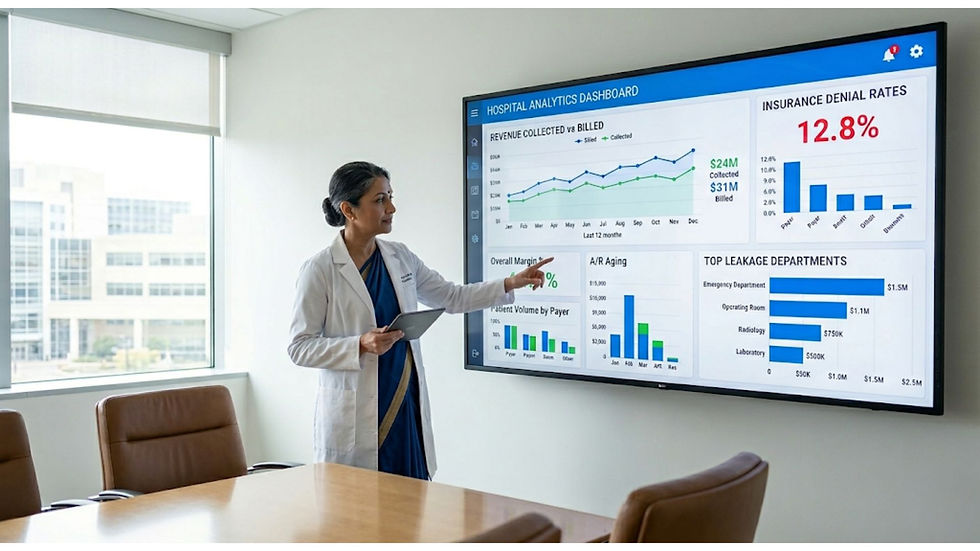
Real-time dashboards allow senior management to monitor revenue trends, departmental performance, and leakage indicators proactively
Cost Reduction Strategies That Preserve Clinical Standards
Cost reduction must always be viewed through the lens of clinical safety and care quality. The objective is not to cut services but to eliminate waste while maintaining—or improving—patient outcomes.
Workforce Optimization
Align staffing levels with real-time patient volume data rather than fixed schedules
Use dedicated patient transport staff to free nursing time for clinical tasks
Reduce overtime costs through predictive scheduling and cross-training
Improving Patient Flow and Bed Utilization
Delayed discharges, extended pre-operative waiting, and inefficient transfer processes all represent dual losses—reduced throughput and increased operational cost. Token and queue management systems, when integrated with the HMS, provide real-time visibility into patient movement, enabling proactive intervention before delays cascade.
Administrative Efficiency and Regulatory Advocacy
Digitize and automate routine administrative tasks—referral management, appointment confirmation, discharge summaries
Reduce redundant documentation by standardizing clinical note templates
Engage with regulatory bodies to advocate for streamlined compliance reporting processes
Invest in energy conservation measures: solar installations, wastewater management, and LED retrofits contribute meaningfully to long-term operational savings
Clinical Illustration: A teaching hospital struggling with prolonged average length of stay (ALOS) implemented a coordinated discharge planning protocol involving daily multidisciplinary rounds at 8 AM. Discharge decisions were made 24 hours in advance, paperwork prepared overnight, and patient transport scheduled proactively. Within three months, ALOS for elective surgical patients fell from 4.8 to 3.6 days, improving bed availability by 20% and significantly boosting surgical throughput revenue.

Accounts Receivable Management: Closing the Cash Cycle
Active receivables management is essential for sustaining healthy cash flow. Billing a patient or insurer is only the first step; collection is where financial performance is ultimately measured.
Segment outstanding receivables by age, payer type, and value
Assign dedicated follow-up responsibility for over-aged accounts
Perform root cause analysis on delayed payments to identify systemic issues
Set internal escalation thresholds for accounts at risk of becoming bad debts
Provide transparent OPD and IPD cost estimates to patients upfront, reducing disputes at discharge
Conclusion: Control Is the Foundation of Clinical and Financial Excellence
The leakage of hospital revenue is not an intractable problem. It is a systems failure—and systems failures can be corrected with the right architecture, governance, and culture. When clinical and administrative leaders work in concert—supported by integrated technology, trained teams, structured audits, and data-driven decision-making—hospitals gain the financial clarity they need to operate with both resilience and purpose.
In summary: "Control gives confidence. Confidence ensures flawless operation."
Financial sustainability and patient safety are not competing priorities in healthcare—they are complementary imperatives. The hospital that invests in revenue integrity today is the hospital that can invest in its patients tomorrow.
Key Takeaways for Hospital Leaders
Revenue leakage of even 1–5% can cost a mid-sized hospital crores annually—most of it preventable.
An integrated HMS is the single most impactful tool for real-time leakage detection and prevention.
Patient engagement tools (SMS, WhatsApp) directly reduce no-shows and abandoned follow-ups—boosting revenue and outcomes.
Supply chain standardization and predictive inventory management eliminate high-cost emergency purchases.
Regular structured audits are essential for translating data into measurable financial improvement.
Staff training on billing and documentation is as important as clinical training—both affect patient care.
Technology and data analytics convert operational complexity into decision-ready intelligence.
Cost reduction must be strategic, not arbitrary—always evaluated against clinical impact.


Comments